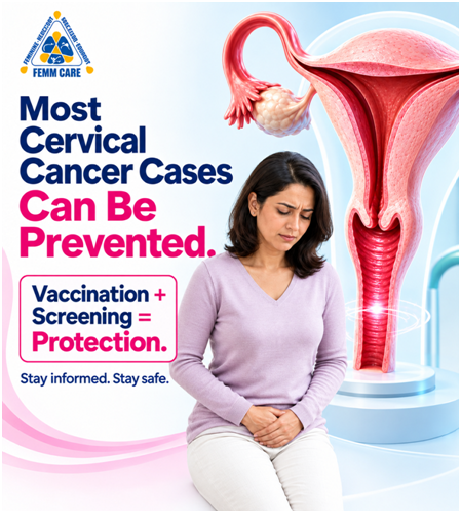
Simple Screening Tests and HPV Vaccination That Can Help Prevent Cervical Cancer
Why Every Woman Should Know About Cervical Cancer Screening and HPV Vaccination
What is cervical cancer and why is it important?
The cervix, often called the neck of the womb, is the lower part of the uterus (womb) that opens into the vagina, or birth passage.
Cervical cancer is cancer that develops in the cervix. Almost all cervical cancers are linked to persistent infection with certain types of Human Papillomavirus (HPV). HPV is a very common virus, and in most people the body’s immune system clears the infection naturally. However, in some women, HPV infection can persist for many years and gradually cause abnormal changes in the cells of the cervix. These pre-cancerous changes may eventually develop into cancer if they are not detected and treated.
The good news is that cervical cancer is largely preventable through HPV vaccination, regular screening and timely treatment of precancerous changes.
What is cervical cancer screening?
Cervical cancer screening means checking the cervix for HPV infection or abnormal cells before cancer develops.
The two commonly used screening tests are:
- HPV DNA test
- Pap smear (Pap test)
These tests are usually simple and can be performed in a doctor’s clinic without surgery or hospital admission.
Screening can identify changes at a stage when they can be treated, helping to prevent cervical cancer from developing.
What is an HPV DNA test?
The HPV DNA test checks for the presence of high-risk types of HPV that can cause cervical cancer.
During the test, a doctor or trained healthcare professional gently collects a small sample of cells from the cervix. The sample is then sent to a laboratory to check for high-risk HPV.
The important advantage of the HPV test is that it can identify a high-risk HPV infection before significant changes develop in the cervical cells.
What is a Pap smear?
A Pap smear, also called a Pap test, looks for abnormal cells in the cervix.
During the examination, a small sample of cells is gently collected from the cervix and examined in a laboratory under a microscope.
The main purpose of a Pap smear is to identify precancerous changes early, so that they can be treated before they develop into cancer.
HPV Test and Pap Smear: What is the difference?
Although both tests are used for cervical cancer screening, they look for different things.
| Pap Smear | HPV Test |
| Looks for abnormal cells in the cervix | Looks for high-risk HPV infection |
| Can detect precancerous cell changes | Can detect the virus that may cause precancerous changes |
| Helps identify cells that may become cancerous | Can identify women at increased risk of developing cervical cell changes |
| May be used alone or together with an HPV test | May be used alone or together with a Pap test, depending on age and guidelines |
Your doctor will recommend the most appropriate screening method based on your age, medical history and available testing facilities.
Why is cervical cancer screening important?
Cervical cancer can develop slowly and may not cause any symptoms in its early stages. Precancerous changes also usually do not cause symptoms.
Regular screening can:
- Detect high-risk HPV infection
- Detect abnormal or precancerous cervical cells
- Allow treatment before cancer develops
- Reduce the risk of developing advanced cervical cancer
- Increase the chances of successful treatment if cancer is detected
This is why regular screening is important even when you feel completely healthy.
What causes cervical cancer?
The main cause of cervical cancer is persistent infection with high-risk types of HPV.
HPV is very common and is usually transmitted through sexual contact. Most HPV infections disappear naturally within one or two years. However, when a high-risk HPV infection persists, it can gradually cause changes in the cells of the cervix. Over several years, these changes may develop into precancer and, eventually, cancer.
This slow progression that takes about 12 to 15 years provides an important opportunity for screening and treatment before cancer develops.
Who should have cervical cancer screening?
Screening recommendations can vary between countries and guidelines. In India for women at well-resourced setting, the starting age of cervical cancer screening at age 25years and in low resourced setting it is 30 years. Any sexually active woman below 25 should ideally get Pap smear or HPV DNA screening tests done.
- Women aged 25–65 years may undergo:
- Pap test alone every 3 years
- HPV test alone every 5 years
- Or co-testing (Pap + HPV test) every 5 years depending on medical advice.
- You may need more frequent screening if you have:
- Previous abnormal reports
- Weakened immunity
- History of cervical precancer
WHO recommends HPV-based screening as the preferred high-performance approach in its global cervical cancer elimination strategy, with screening beginning at different ages depending on the national programme.
What happens during a cervical cancer screening test?
Many women feel nervous or embarrassed about the examination. However, the procedure is usually quick and straightforward.
During the examination:
- You will lie comfortably on an examination table.
- A small instrument called a speculum is gently inserted into the birth passage so that the cervix can be seen.
- A small brush or spatula is used to collect a few cells from the cervix.
- The sample is sent to a laboratory for testing.
The actual sampling generally takes only a few minutes. Some women may experience mild pressure or discomfort, but the procedure is usually brief.
How should I prepare for the test?
Preparation may vary depending on the type of test.
Your doctor may advise you to:
- Avoid using vaginal creams or medicines shortly before the test, unless advised otherwise.
- Avoid scheduling the test during heavy menstrual bleeding.
Always tell your doctor if:
- You are pregnant.
- You have symptoms of a vaginal or cervical infection.
- You have had an abnormal cervical screening result in the past.
What does a normal result mean?
A normal Pap test means that no abnormal cervical cells were found.
A negative HPV test means that the high-risk HPV types being tested for were not detected.
A normal result is reassuring, but it does not mean that you will never develop cervical cancer. Continuing screening at the recommended intervals remains important.
What if my HPV test or Pap smear is abnormal?
An abnormal screening result does not automatically mean that you have cancer.
Many abnormal results are due to early or mild changes that can be monitored or treated.
Depending on your result, your doctor may recommend:
- Repeat HPV testing or Pap testing after a certain period
- Additional testing like Colposcopic Examination
- A cervical biopsy, if required
A colposcopy is a closer examination of the cervix using a computerised instrumentwith special magnifying camera. If an abnormal area is seen, a small tissue sample may be taken for further examination.
The important thing is not to panic, but to complete the recommended follow-up.
Is cervical cancer screening painful?
This is one of the most common concerns among women.
Most women describe the examination as:
- Mildly uncomfortable
- A feeling of pressure
- Brief and tolerable
The examination usually takes only a few minutes.
Trying to relax your pelvic muscles and taking slow, deep breaths can make the examination more comfortable.
Can screening prevent cervical cancer?
Yes.
This is one of the most important benefits of cervical cancer screening.
Cervical cancer usually develops gradually. Screening can identify HPV infection or precancerous changes before they progress to invasive cancer. When precancerous changes are detected and appropriately treated, cervical cancer can often be prevented.
Can HPV vaccination help prevent cervical cancer?
Yes.
HPV vaccination protects against infection with HPV types that can cause cervical cancer and other HPV-related diseases.
WHO recommends HPV vaccination as an important part of cervical cancer prevention, particularly for girls aged 9–14 years, before they become sexually active.
HPV vaccination works best when given before exposure to HPV. However, vaccination may also be appropriate for older adolescents and adults depending on age, previous vaccination, individual circumstances and the vaccine being used.
What HPV vaccines are available In India?
HPV vaccines are available in different formulations.
For example:
- Quadrivalent vaccines such as Gardasil and Cervavac can protect against four common cancer causing HPV types, including types 6, 11, 16 and 18.
- Nonavalent vaccines, such as Gardasil 9, prevents nine HPV types and gives slightly better protection.
Who can receive the HPV vaccine?
- Girls and women from age 9 years to 45 years can take this vaccination.
- However it works best for the girls between 9 and 14 years.
The vaccine can provide the greatest benefit when given before sexual exposure, but an older person may still benefit from vaccination.
Your doctor can advise you about whether vaccination is appropriate for you.
What is the HPV vaccination schedule?
The number and timing of HPV vaccine doses depend on age, immune status and the specific vaccine or national programme.
- As per Indian Government policy the girls between 9 and 14 years should take two dosage 6 months apart (0 & 6 months)
- Form girls of 15 years to women of 45 years need three dosage in six months (0, 2 & 6 months)
Is HPV vaccination safe?
HPV vaccines have been extensively studied and are generally considered safe.
Most side effects are mild and short-lasting. They may include:
- Pain, redness or swelling at the injection site
- Mild fever
- Headache
- Tiredness
Serious reactions are uncommon. Your doctor or vaccination provider can explain the possible side effects and precautions before vaccination.
Does HPV vaccination mean I don’t need cervical cancer screening?
No.
This is a very important point.
HPV vaccination significantly reduces the risk of HPV infection and HPV-related cancers, but it does not protect against every HPV type that can cause cervical cancer.
Therefore, women who have received the HPV vaccine should still undergo cervical cancer screening according to the recommended schedule.
In simple words:
Vaccination helps prevent HPV infection.
Screening helps detect HPV infection or precancerous changes early.
Together, vaccination and screening provide powerful protection against cervical cancer.
What symptoms should never be ignored?
Early cervical cancer and precancerous changes may cause no symptoms at all. That is why screening is important even when you feel perfectly well.
However, consult a gynaecologist if you experience:
- Bleeding after sexual intercourse
- Bleeding between periods
- Unusual or foul-smelling vaginal discharge
- Pelvic pain
- Bleeding after menopause
These symptoms do not necessarily mean cancer, but they should not be ignored and should be evaluated by a doctor.
Final Message
Cervical cancer is largely preventable.
HPV vaccination can help prevent infection with HPV types that cause cervical cancer, while regular cervical cancer screening can detect HPV infection or precancerous changes early—often before cancer develops.
Do not postpone screening because of fear, embarrassment or the belief that you are healthy. The test is simple, usually takes only a few minutes, and can potentially prevent a serious disease.
If you have never received the HPV vaccine or have never undergone cervical cancer screening, talk to your gynaecologist about the right vaccination and screening plan for you.
Remember:
VACCINATION + SCREENING = PROTECTION
This article is intended for general health education and does not replace individual medical advice. Screening and vaccination schedules should be followed according to current national guidelines and your doctor’s advice.
The medical points above are aligned broadly with current WHO and CDC information; importantly, screening recommendations differ somewhat between international guidelines, so I have avoided presenting one country’s schedule as universal.